I don’t know about you all, but for the past year I have been having a super hard time remembering what day of the week it is, much less what the date is. Everything seems to run together, and one day just drifts into the next–particularly if I can’t sleep so I don’t go to sleep until the new day has technically arrived already.
That feeling of temporal distortion or disorientation plays into our topic for today: time.
When historians start to write the history of this pandemic, they’re likely going to tell the story in roughly chronological order. That’s how we tell stories, generally speaking. And that’s how I want you to tell your story too. But I do want us to think about what time really is, and how different perspectives on time can change the stories we tell.
Thinking about time’s structure
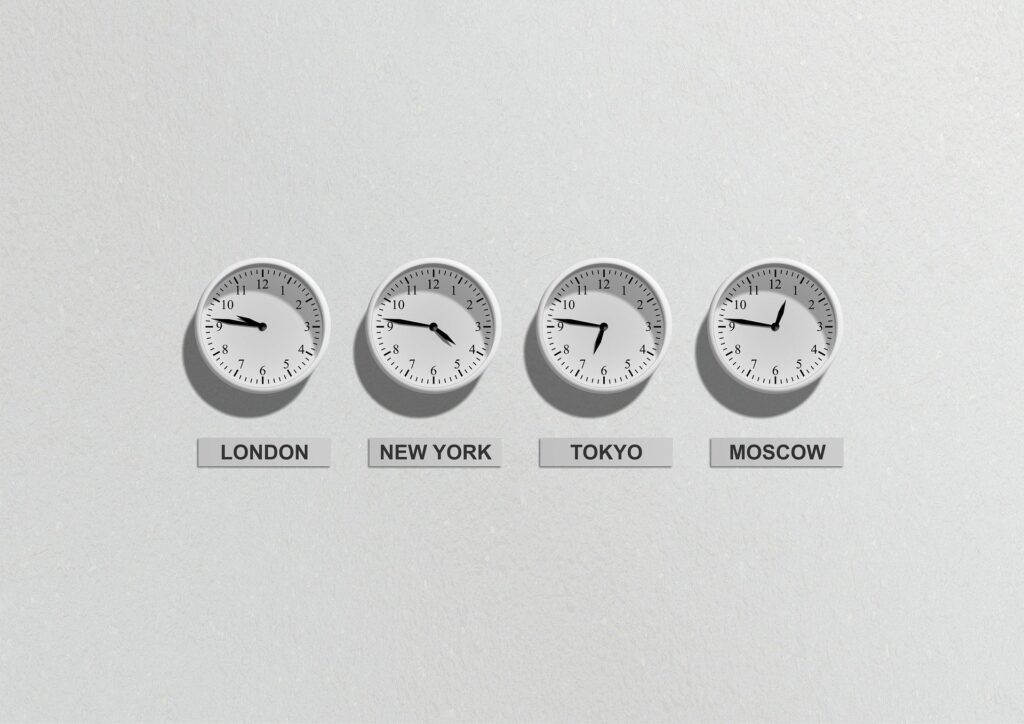
Let’s think about time’s structure. We measure time in a lot of different ways, some ways more “scientific” and precise than others. We often think of clocks or calendars as being the same as time, but the reality is that time is much more complicated.
There are two main ways we can think about time: linear and cyclical. We can associate linear with the “passage of time”: past, present, and future. The things that came before us are different from the things that are now and will be. We use eras and epochs to mark the passage of time on a grand scale; on a smaller scale, we use calendars and dates. And yet, calendars aren’t entirely linear. They’re also cyclical.
Thinking of time as cyclical emphasizes continuity, rather than change. How is this moment like other moments previous, or moments to come? Cyclical time is marked by day and night, which happen regularly; by seasons; by school years, even. Many people groups throughout history have cared more about cyclical time than linear time.
So let me give you a few illustrations about how linear and cyclical time intersect that matter for the study of history. Clock time was not widely adopted until the advent of technology that made it easier to keep accurate time, and more advantageous to keep uniform time. In other words, it wasn’t worth having a clock if it didn’t have the same time as all the other clocks around you. So the technology had to be simple enough that everyone who owned a clock could keep it going.
For a long time, it didn’t much matter if things happened at exactly a specific time. It wasn’t until industrialization and the transportation revolution that it became important to know specific times. The biggest driver of the adoption of clock time was probably factories and trains. You had to know when to be at the station to make sure you got on the train.
Developing collective units of time isn’t an easy thing. Who decides how long a “second” is, or a “minute”? How did we end up having a calendar that has leap days? The answer is part science and part politics.
We have to go back to Roman times to start answering the question. The calendar the Romans used (called the Julian calendar) included a leap day every four years, without exception. It’s called the Julian calendar because it was established under Julius Caesar, not because he invented it. The Julian calendar had too many leap days because it ever-so-slightly miscalculated the length of time required for the earth to go around the sun.
In the 1500s, people wanted to fix the problem of too many leap days. So a new calendar was proposed, with much more complex rules for calculating a leap year (it’s every 4 years, unless it’s a year divisible by 100, in which case it ISN’T a leap year; unless it’s also divisible by 400, and then it IS.)
Pope Gregory XIII proposed the Gregorian calendar in 1582; many Catholic-majority countries adopted it within a few years. See–power and politics. The pope had authority in these countries, so he imposed the new calendar. Other countries who didn’t recognize the political authority of the pope were slower to adopt the new calendar. In fact, some other countries didn’t adopt it precisely because it originated with the Catholic church. The British empire didn’t switch to the Gregorian calendar until 1752. Several other countries, including Greece and Turkey, didn’t until the 1920s. If you were still using the Julian calendar now, you’d be behind Gregorian time by 14 days.
But we’re making a big assumption here: that people who nominally recognize the Gregorian calendar use it as their primary way to mark the passage of time. The reality is that many of us use the Gregorian calendar as only one of many ways to mark time. We can see this on the calendar level with religious traditions. The Islamic calendar is only 354 or 355 days. The Christian liturgical calendar starts with Advent, 4 weeks before Christmas. The Jewish calendar marks time since the creation of the world, though perhaps not literally, whereas the Christian calendar widely adopted in Western culture marks time before and after the birth of Jesus (whether you call it that or not). And these are just the Western religious traditions.
Telling stories with time
So as you think about time, rather than thinking of it as a universal understanding, bear in mind all the ways that time could be different for different people.
We’ve talked a lot about telling stories. Time is a critical piece to how we tell stories, with a beginning, middle, and end. Not all stories have these elements. But all stories have a sense of time of some kind.
When we’re telling historical stories, we have a sense of time as well. We pick the events that seem the most significant and we tell those stories.
So here’s your first question to consider in our #discussion channel.
First, think of how you’d want to tell someone the story of your day yesterday.
Take 3min to write down the events of your day yesterday that best encapsulate the way you’d tell someone who asked you “What did you do today?”
OK, now, starting over, write down the same number of events but for the last month.
OK, now, starting over, write down the same number of events but for the last year.
If you feel comfortable, share these various versions of your life in the discussion channel. I’ll do it too.
How did you decide what events to include? This is a particularly fraught question because in some ways, we’re living in the middle of a time shift. How we see our lives right now probably looks really really different from if we’d done this just one month ago. Our priorities for the important things in our life might be radically different, and there’s a good chance those priorities could change again at any moment. We see the passage of an entire year that feels lost, in a lot of ways, and yet it now feels like time has slowed down again as we wait for vaccinations and the end of the first phase of this covid nightmare.
Doing history means choosing which things are important. It could mean including the nitty-gritty details of every single day, if you’re focusing on one event. It could mean leaving out even days, weeks, months, or even years if you’re talking about epochs of time. Choosing which things are important is one of the ways in which historians make interpretive choices.
Selecting important events is one of the ways that we can understand the history of the thing we want to study. The logical way to organize these events is in a timeline, which I’ll give detailed instructions about in a separate screencast.
As you’re working on your timeline, keep in mind your perspective. Whose timeline are you creating? There’s no “just the facts” about timelines either, any more than there was about archives, or audio, or anything else we’re doing in this class.
Let me give you an example from our course material: we’ve already talked about some of these time shifts, though we didn’t call them that at the time. Remember how the inciting incidents of the War of 1812 really happened in 1807? Why don’t we mark the War of 1812 as starting with the Chesapeake-Leopard affair, or the embargo, or the Orders in Council? Or why don’t we mark the war as beginning with the Battle of Tippecanoe in 1811? Aside from the fact that we’d have to think of a new name for it, we call it the War of 1812 because we can see a declaration of war by the United States in 1812. But people in the United States were feeling the effects of the conflict for a good 4-5 years before the official declaration. Wars are messier than a declaration at the beginning and a treaty at the end. So timelines are also messier. How far back do you need to go in order to understand what’s going on? How far after the war do you need to advance in order to explain its effects?
These are all questions that historians have to determine when they’re talking about time, and so that’s what I want you to do: think about time, not just for your war, but also for how you’re living right now.

Be the first to comment on "Thinking about Timelines"